Russian Orthodox Church Transfiguration of Our Lord Âĺđńč˙ íŕ đóńńęîě ˙çűęĺ
Baltimore, USA Transfiguration of Our Lord
Online Orthodox Library
Christian Teaching
Our Lord Jesus Crist
Holy Mother of God
Lives of the Saints
Christian Family
Sacraments
Science and Religion
World of the Angels
The Royal Martyrs
Prayers
Modern-day Life
Church and Services

Contact usSpiritual poetryTransfiguration of Our LordChurch choirOur churchHome
Our Lord Jesus ChristOur Lord Jesus Christ
Back to the list
E-mail this page
The Nativity of Christ
The significance of the Baptism of our Lord

On a par with Pascha, the feast of the Baptism of our Lord is one of the oldest Christian holidays. It is dedicated to the baptism of our Lord Jesus Christ in the River Jordan. From ancient times this holiday was celebrated by Christians with great enthusiasm, because it reminded them of their own baptism and promoted within them a deeper awareness of the power of this sacrament.

The event itself of the baptism of our Lord was as follows: when the time came for the Lord Jesus Christ to embark upon His public service, God sent the prophet John the Baptist to preach repentance, in order to prepare the Jewish people for the coming Messiah. According to the holy Evangelist Luke, John the Baptist began preaching in the 15th year of the rule of the Roman Emperor Tiberias. This was approximately in the 779th year from the founding of Rome or the 30th year of the Christian era. At that time the Lord Jesus Christ was still living in His city of Nazareth, in the northern part of the Holy Land – the region called Galilee, where the Holy Family settled since the time of the massacre of the Bethlehem infants by Herod.

John the Baptist’s teaching was simple, but it penetrated the very soul of his listeners: “Repent ye, for the Kingdom of Heaven is at hand,” – said the prophet. The site of John’s preaching was the Judean wilderness – the sparsely populated area comprising the western shores of Jordan and the Dead Sea, dotted with rocky hills and dried up streams, with very sparse vegetation, which is why it was called a wilderness. The prophet John, son of the righteous Zacharias and Elizabeth, became orphaned very early and grew up in this wilderness. There he became accustomed to an extremely harsh way of life. He wore a garment made out of camel’s hair, girdled with a leather belt, and ate locusts and wild honey.

After the boring sermons of the Jewish scribes, discoursing primarily on the correct performance of various religious rites, the preaching of John the Baptist swept the entire Judea as a breath of fresh air. The inhabitants of Jerusalem, Judea, and even Galilee and Samaria thronged to him to hear the living and inspired words of this prophet of God.

Seven hundred years before the birth of Christ the famous prophet Isaiah foretold in his book of the preaching of John the Baptist. Isaiah calls the prophet John “the voice of him that crieth in the wilderness,” who was to “prepare the way of the Lord, make straight His steps.” The Old Testament prophet Malachi, who lived about 400 years before the birth of Christ, also foretold of John the Baptist. He calls John an angel of the Lord (“angel” means messenger in Greek), saying on behalf of God: “Behold, I will send My messenger, and he shall prepare the way before Me.”

With his appeal for repentance the prophet John impressed upon the Jews the need to profoundly realize the error of their ways, to condemn their sinful life, and to begin a new one based upon God’s commandments. The word “repent” – metanoin in Greek – means “to change one’s worldview,” to look upon life in a new way. Moreover, the prophet John insisted upon the repentance being sincere, wholehearted, and accompanied by self-correction and good deeds. “Bear fruit worthy of repentance,” – the prophet told the Jews. To the frequently asked question “what to do?” the prophet replied: “Whoever has two pieces of clothing, give to the one who has not”– in other words, do good and help the needy. The publicans (tax collectors) the prophet persuaded not to extort more taxes than was legally required. The soldiers he taught not to offend anyone, not to slander anyone, and to be content with their earnings.

However, not all Jews came to the prophet with the desire to hear the living word of God and with the intention to correct their lives. Some came out of idle curiosity or to find fault in an incautious word on the prophet’s part, in order to accuse him before the authorities. Among the prophet’s ill-wishers were the Jewish scribes and the Pharisees, who envied the prophet his glory and feared to lose their authority among the people. They prided themselves on their knowledge of the law, on their ritual “righteousness,” and looked with disdain upon simple and illiterate folk. The prophet John, seeing the hypocrisy and malice of the Jewish leaders, their unwillingness to turn to God, denounced them openly and quite strongly, saying: “O generation of vipers! Who hath warned you to flee from the wrath to come?”

However, the ones who repented and confessed (i.e. openly declared) their sins, the prophet John baptized in the River Jordan. The baptism consisted of the repentant’s prayerful immersion in water, which symbolized the cleansing of sins. The prophet John’s baptism was not yet the grace-filled Christian baptism, but a preparation for it. In calling the forthcoming Kingdom of the Messiah a heavenly one, the prophet John gave to understand that the Messianic kingdom would not be what many Jews incorrectly imagined it to be – a powerful and rich state. In reality, the Kingdom of the Messiah would be heavenly and spiritual, summoning people to God and granting them moral renewal.

Looking at John, some of the Jews asked themselves whether it was he who was the awaited Messiah? But the prophet John decisively declined such an honor, explaining to them that his task was only to prepare people for the coming Messiah. He, John, was baptizing them in water as a sign of repentance, while the Messiah would baptize them “with the holy spirit and fire.” In other words, the new baptism would not simply be a symbolic cleansing like John’s baptism, but would be a grace-filled renaissance of the person. In the Messianic baptism the Holy Spirit Himself, acting as fire, would burn away people’s sinful impurity and would kindle within their hearts an ardent desire to serve God. Those who accept the Messiah will be gathered by God into His Kingdom, like wheat is gathered into a granary, while those who oppose Christ will be burned by God like straw in an inextinguishable fire.

The Evangelists continue their narrative by saying that “then” – during one of John the Baptist’s sermons on the shores of the River Jordan – “cometh Jesus from Galilee to Jordan unto John, to be baptized of him.” Why did the sinless Jesus come to be baptized? The answer to this question we receive from John the Baptist himself, who several times before this event explained to the members of the Sanhedrin (the Jewish supreme religious council): “For this I have come to baptize with water, in order that He (Christ) be made manifest to Israel,” in other words, that the baptism reveal who He really is. Up to that time Jesus Christ lived in the solitude of Nazareth, known only to the inhabitants of his small hometown as the son of Mary and the carpenter Joseph. Now Christ had reached the age of thirty and, according to Jewish law, received the right to instruct people and call Himself a “rabbi” – teacher. The time had come for Him to reveal Himself to the people, and for the people to hear witness of Him as the long-awaited Messiah. This is what happened now on the shores of Jordan.

However, when the Lord approached John, the latter sensed His great and divine holiness, and he said to Jesus: “I have need to be baptized of Thee, and comes Thou to me?” To this the Lord replied: “Suffer it to be so now, for thus it becometh us to fulfill all righteousness.” By the word righteousness Jesus Christ means the will of God. It was the will of God that all who wished to become members of the grace-filled Messianic Kingdom should be baptized. Baptism took on the meaning of a “door” into the Kingdom of God. As the progenitor of the new mankind that was restored by Him, Jesus Christ was due to enter first into the Kingdom which He was establishing, to open the way to salvation for people, and to teach them to fulfill the will of God. Simultaneously, the Saviour’s immersion in water at the moment of His baptism also had the aim to sanctify baptism, to turn this symbolic rite into a grace-filled, restorative Christian sacrament.

All those who came to John first confessed their sins and then immersed themselves in the water. Jesus alone, being sinless, came to John to be directly baptized. After being baptized, Jesus came out of the water immediately and began praying on the shore. At this point He, as the Son of God, was asking His Heavenly Father to bless the beginning of His public service. Suddenly, while Jesus was still praying, the heavens opened and the Holy Spirit descended upon Jesus from there in the form of a white dove. At the same time the voice of God the Father was heard from there, saying: “This is My beloved Son, in Whom I am well-pleased.” These words of God the Father were an indication to John and all the people present of the Divine dignity of the Messiah, Who was not only a Man, but also the Only-begotten Son of God.

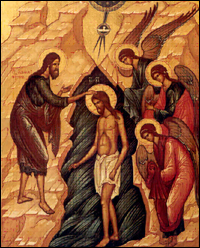
Baptism of our Lord.

The triple miracle which took place here – the opening of the heavens, the descent of the Holy Spirit in the form of a dove, and the witness of God the Father – fully convinced the prophet John that Jesus Christ was indeed the awaited Messiah. The prophet John was actually waiting for this visible descent of the Holy Spirit upon the Messiah, because in the very beginning, sending the prophet out to preach, God had said to him: “Upon whomever thou seest the Spirit descend and remain upon Him, He is the one Who shall baptize with the Holy Spirit.” Thus, from this time on, John the Baptist unhesitatingly bore witness to all about Jesus being the Messiah and the Lamb of God Who had taken upon Himself the sins of the world. Soon after the Lord Jesus Christ’s baptism, the prophet John ceded to Him several of his own disciples: the brothers Andrew (the First-called) and Peter, and the brothers James and John (the Theologian). Adhering to the Saviour, they became His first disciples and apostles.

Bishop Alexander (Mileant)

On the day of the Lord’s Baptism we commemorate the miracle of Theophany (Theo-fania in Greek) or the revelation of God. In truth, when the Saviour was baptized, the one and all-mighty God, Creator of heaven and earth, for the first time revealed Himself to mankind as Three Persons: God the Father – by His voice; God the Son – by His baptism in the river Jordan; and the Holy Spirit – by descending in the form of a dove. For this reason the troparion of the Lord’s Baptism says that on this day “the worship of the Trinity was made manifest.”

The feast of Theophany or the Baptism of our Lord occupies a special place among the twelve major Church feasts. It reminds us of our spiritual birth on the day when a priest thrice immersed us in water. It also reminds us of the vows we gave at the holy font, if not consciously due to our tender age, then in the promises made by our godparents, who subsequently were called upon to explain to us the significance of the sacrament of baptism and the meaning of Christian teaching.

For a Christian, says a first-century Church Father, St. Cyril of Jerusalem, the baptismal waters are “both a tomb and a mother.” They are a tomb for his former sinful life outside of Christ, and the mother of his new life in Christ and His Kingdom of eternal truth. Baptism is the door leading from the kingdom of darkness into the kingdom of light. “As many as have been baptized into Christ, have put on Christ”… – whoever has been baptized in Christ’s name becomes attired in the robe of Christ’s righteousness, becomes a participant in His holiness. The power of baptism lies in the fact that the baptized person is endowed with the ability and strength to love God and his fellow beings. Such Christian love draws the Christian towards a righteous life and helps him overcome his attachment to the world and its sinful delights.

The misfortune of many present-day Christians is that they labor very little to kindle more brightly in their hearts the flame of grace-filled love which they have received. A painful attachment to the world has edged spiritual love out of them and has brought with it grief, malice and envy.

Thus, while celebrating the great feast of our Lord’s Baptism, let us remember the vow we gave at our own baptism to love God and our fellow beings. Let us thank God for having vouchsafed us spiritual rebirth and for having summoned us into His Kingdom of eternal bliss. Let us try to become worthy of this great honor and mercy on the part of God!

Bishop Alexander (Mileant)
Homily for the Baptism of Our Lord

The Lord Jesus Christ did not begin His open preaching of the Gospel until the age of 30, because the Jews did not accept anyone below that age as a teacher or priest, and this rule has also been incorporated into the Christian Book of Rules.

When the time came for Him to preach salvation, by God’s command He was preceded by John the Forerunner, who proclaimed throughout all the environs of the Jordan River that the Heavenly Kingdom was at hand, and that the awaited Messiah was coming… John preached repentance, necessary for entering this Kingdom, and baptized in the river Jordan all those who confessed their sins. This baptizing, which merited John the name of the Baptist, was, according to St. John Chrysostome, only a preparation for the sacrament, and not the sacrament itself. The Lord Jesus Christ, upon coming to the river Jordan and sanctifying the waters by immersing His most holy Self in them, thereby established the sacrament of baptism, which serves as a door into a new and eternal covenant with God. It was not the water that cleansed Him, Who was most-pure and without sin, but He Who sanctified the water by deigning to lave Himself in it, as is sung in the office of the great blessing of the waters: “Today is the nature of water sanctified.”

Before embarking upon His universal preaching, Jesus Christ also came to John to be baptized in the Jordan River. The Forerunner had never seen the Saviour, but God revealed to him that this was the Messiah. Then John exclaimed in pious awe: “…I have need to be baptized of Thee, and comest Thou to me?” “Suffer it to be so now,” – the Lord replied to him, – “for thus it becometh us to fulfill all righteousness” (Matt. 3:14-15).

After that John placed his hand upon the head of Jesus Christ and immersed Him; in the words of the church hymns, the Lord takes upon Himself the sins of the world and is covered by the waters of Jordan. When the Lord came out of the water, the heavens opened above Him, and John saw the Spirit of God, Who was descending upon Christ in the form of a dove, and the voice of God the Father was heard: “This is My beloved Son, in Whom I am well pleased” (Matt. 3:17). In this manner God appeared as the Holy Trinity.

The Baptism of our Lord

In commemorating this event on the Jordan River, the Church established the feast of the Lord’s Baptism to be celebrated on January 6th (19th by the new calendar). This holiday is also called the day of Theophany. Why is that? For the following reason: this holiday is distinguished by the fact that, as is sung in its troparion, on this very day “the worship of the Trinity was made manifest.” For the first time all three Persons of the Holy Trinity revealed Themselves individually: people heard the voice of God the Father, God the Son was being baptized by John, while the Holy Spirit descended from the Father upon the Son in the form of a dove.

St. John Chrysostome says: “It is not the day on which the Saviour was born that should be considered as the day of His revelation, but the day on which He was baptized. He did not become known to all through His nativity, but through His baptism…”

The beginning of this holiday dates back to the apostles, it is mentioned in apostolic decrees. St. Clement of Alexandria bore witness to the celebration of the Lord’s Baptism in the second century. There is also mention that the feasts of Christ’s Nativity and Baptism were merged into one celebration, which lasted from December 25th to January 6th (by the old calendar).

In His Nativity and Baptism the Lord teaches us humility, as opposed to the vanity and egoism on which contemporary mankind prides itself. Let us learn from our Saviour, dear brethren, this God-pleasing and fragrant virtue, without which, according to the Holy Fathers, no other virtue can be complete. Amen.

Protopriest Igor Hrebinka

Have you noticed, dear brethren, how the Church ties in our lives with church life, with events in the life of Christ? During the days of Christ’s Nativity we knelt before the manger of Christ, we became the sons of God. Then, beginning the civil New Year, a new circle of time which brings us ever closer to eternity, we were summoned to renew ourselves too, to renew our souls, cleansing them of sin and passion, to renew our hearts, filling them with virtue and love for God and our brethren.

And now today the Church calls us to the shores of the river Jordan, where the great sacrament of Theophany, or the appearance of God, will be revealed to us. Today, dear brethren, we are celebrating the great feast of the Baptism of our Lord Jesus Christ. And we must understand it properly, we must properly prepare ourselves.

The holy Evangelist Mark describes the event very briefly and simply: “And it came to pass in those days that Jesus came from Nazareth and was baptized by John in Jordan. And straightway, coming out of the water, John saw the heavens opening, and the Spirit descending upon Jesus like a dove. And there came a voice from heaven, saying: Thou art my beloved Son, in Whom I am well pleased.”

This sparse description reveals to us, however, the depth of our salvation. First of all, for the first time in the history of mankind, the Lord God shows Himself fully – that is, openly reveals the mystery of Himself as God the Trinity; for this reason the holiday is also called Theophany.

In the Old Testament, the people of Israel were primarily exposed to the fact of One God, in order to closely guard this principle in the midst of the paganism of the surrounding peoples. But even in those days there were hints of the triunity of God. Thus, for example, the Lord appeared to Abraham in the guise of three angels or three strangers. And in the Book of Genesis Moses describes the creation of man by saying: “And God created man in His image”; but earlier, while holding council over this matter, God says: “Let Us create man in Our image and in Our likeness.”

And now, in the New Testament, the Lord finally reveals Himself openly – in the feast of Theophany we witness the Trinity: God the Father gives His blessing from heaven, God the Son is baptized for our salvation in the river Jordan, and God the Holy Spirit descends as a dove – the symbol of meekness and purity.

In the feast of Nativity the Church pointed out to us, that since the Saviour of the world has been born on earth, there is salvation for us, we all have the opportunity to be saved. Now, in the feast of Theophany the Church shows us how to achieve this salvation: just as people once came to John the Baptist, were baptized in the waters of Jordan and were cleansed of their sins, so we should come to the church of Christ and purify ourselves through church sacraments. And in order to help us, and also as tangible proof of the grace of God, there is the great blessing of water on the feast of Theophany.

Baptism of our Lord
Baptism of our Lord

By His Baptism the Lord Jesus Christ drowned our sins and blessed the very element of water. Thus, when the priest blesses any water, the grace of the Holy Spirit descends upon it, and this formerly plain water becomes a source of healing and salvation for us, and when we are baptized – it even washes away our sins. But the rite of blessing water in honor of the Lord’s Baptism is called the Great Blessing of the Water because of the truly great power which epiphany water possesses. While blessing this water and summoning the unique grace of the Holy Spirit upon it, the priest prays that all who drink this water be cleansed in body and spirit, that they be healed of illness, and that they keep this water for the blessing of their homes.

Make sure to come to church, dear brethren, on the day of the Baptism of our Lord, in order to become participants in the great mystery of the revelation of God as Trinity, and in order to receive the visible grace of epiphany water. Amen.

Father Rostislav Sheniloff

Over the course of the past two weeks, dear brethren, we have been commemorating those extraordinary events of 2,000 years ago which were a turning point in the history of mankind. And that means that these events had a profound influence on our lives as well.

We have recently celebrated the Nativity of Christ. Why did the Lord come down to earth and was born in the form of man? In order to exonerate us from the ancient damnation which fell upon mankind as a consequence of the sin of Adam and Eve. After the fall of our forebears, mankind descended further and further into the abyss of sin, and among all of humanity not a single person could be found who was righteous enough to expiate the original sin. God Himself was needed to atone for it, because the original sin was terrible not so much in its own self, but because it opened the door to all the other sins, and evil was thus able to freely spread over the entire universe and enter the fabric of man’s life on earth. To rectify this situation required the Son of God, the only One without sin, Who alone could carry the burden of the sins of the entire world. It is for this reason that the Lord was born as man.

Then, a week later, we celebrated the Circumcision of the Lord. Why did the Lord, being the Creator of the universe and of all laws, suffer the fulfillment on Himself of this Old Testament law? In order that through His own circumcision, dear brethren, He, Who was entirely without sin, could symbolically circumcise all of our sins, circumcise all that was old and worn out in mankind, and renew man completely.

Baptism of our Lord
Baptism of our Lord

And now we are celebrating the Baptism of our Lord. Why did the Lord, Who was absolutely pure and without sin, come to the river Jordan to be baptized by John like all the other repenting sinners? In order to drown all our sins in the waters of the river Jordan, in order to cleanse us of all impurity, enlighten us, vest us in the snow-white garments of original creation, return us once more to being the crown of creation, such as Adam was when he left the hands of the Creator. At the same time, by immersing Himself in the river Jordan, the Lord sanctified for all ages the element of water, of which we are primarily composed, and made this element salvific and healing for us: salvific, because we are baptized in water and through this baptism we become members of the Body of Christ, that is, the Church; and healing, because now we have holy water which we drink to heal our physical and spiritual infirmities, and with which we bless our abodes and our environment, in order to chase away the evil spirits.

And all of this the Lord has done for every one of us, dear brethren, has showered these innumerable blessings on each one of us. Let us reply to the Lord in kind: with love and gratitude; let us try to put aside all our sins as some old and motley garment; let us wash away our sins through repentance and communion; let us try to be spiritually reborn into a new life.

Let us also try to understand the essence and the depth of these holidays which we are now commemorating, in order to realize their very real importance to us. In the service for the feast of Epiphany there is a wonderful hymn which describes the holiday in the following moving words: “God the Word, having appeared to mankind in the flesh, stood in Jordan to be baptized. And John the Baptist said to Him: ‘How shall I stretch forth my hand and place it over the One Who in His hand holds everything? Even if Thou art an Infant born of Mary, still I know that Thou art preeternal God! And although Thou, Who art glorified by the Seraphim, now walk on earth, Thy servant has not yet learned how to baptize his Master.’ O, unfathomable Lord, glory to Thee!” Amen.

Father Rostislav Sheniloff

Home    Our Church    Services    Church Choir    Contact Us
Transfiguration    Spiritual poetry    Library
Top page
© 2008 Transfiguration of Our Lord Russian Orthodox Church.