|
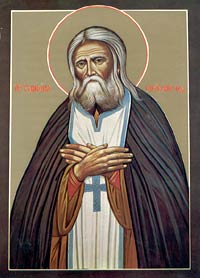
St. Seraphim teaches us that there are three wills: one is Satanic – destructive, which encourages the doing of good for the sake of vanity and pride; the second is human – neither salvific, nor destructive; and the third is the will of God – salvific. We can know this will from reading the word of God. Such reading brings forth tears, warms the soul with tenderness, and fills the heart with the gifts of a spiritual, grace-filled life. Such a life finds its meaning only in the acquisition of the Holy Spirit. The grace-filled power of the Holy Spirit maintains within us internal unity and spiritual purity, gives us strength for an unimpeded striving towards perfection through constant obedience to the Creator, fills the soul with the joy of being, and leads us to God, in order to live an immortal life together with Him.
Such is salvific spiritual life according to the teaching of St. Seraphim. If we were to ask ourselves – do we live such a life? – we would find an answer in the following example. If someone, standing and praying in church, is unable to overcome physical weakness and goes out, as an obedient servant of his body, for a smoke or idle talk, – such a one does not lead a spiritual life. If someone, getting up from sleep, is unable to overcome the soul’s attraction for material concerns and carelessly leaves his bed without the sign of a cross and a prayer to God, – such a one does not lead a spiritual life. If someone does good only for the sake of vanity and strives for perfection without Christ, – such a one does not lead a spiritual life. If someone has not acquired the habit of testing the will of God in his actions and making sure they are pleasing to Him, – such a one has not yet stepped onto the path of spiritual life.
And finally, whoever lives outside the true, holy, and orthodox Church, without confession and communion, without the grace-filled aid of the gifts of the Holy Spirit, – such a one cannot lead a salvific spiritual life. A salvific spiritual life is possible only within the church community and with the aid of the grace of the Holy Spirit.
This is the kind of life that our Lord Jesus Christ has restored to us, and the kind of life to which we are called by the glorified saint of God – St. Seraphim.
On penitence
Whoever wishes to be saved should always have a penitent and contrite heart: “The sacrifices of God are a contrite spirit; a contrite and humble heart, O God, Thou wilt not despise” (Psalm 51:17). In such contrition of spirit a man can easily and harmlessly pass through the cunning wiles of the devil, whose entire efforts are directed at agitating man’s spirit and sowing chaff under the cover of this agitation, as the Gospel says: Sir, did not Thou sow good seed in the field? From whence then hath it tares? He said unto them: An enemy hath done this (Matt. 13:27-28). When man tries to have a humble heart and to preserve his thoughts in peace, then all the enemy’s snares become ineffectual, for God Himself abides wherever there is peace of mind.
Penitence is engendered by the fear of God and attentiveness to oneself: the fear of God is the father of attentiveness, while attentiveness is the mother of inner tranquility. The fear of God awakens the sleeping conscience which, in turn, makes the soul view itself as though reflected in some pure and calm pool of water and see its own ugliness, and thus are born and grow the roots of penitence. Throughout our entire lives our sins offend God’s majesty, and for this reason we must continuously ask God to forgive us our transgressions.
Can man arise through repentance after having fallen? He can: when the holy Prophet Nathan denounced King David’s sin, the latter, upon repenting, was immediately forgiven.
Another example is a certain desert dweller, who went to get water and fell into sin at the spring. However, upon returning to his monastic cell, he recognized his sinfulness and continued to lead an ascetic life as before. The enemy attacked him, pointing out the heaviness of his sin and denying the possibility of his ever receiving forgiveness, and thus tried to deflect him from an ascetic life. But the soldier of Christ stood firmly on his path. God revealed all of this to one of the blessed fathers and directed him to honor the sinning brother for such a victory over the devil.
When we repent sincerely of our sins and turn to our Lord Jesus Christ with all our hearts, He rejoices in us and holds a feast, to which He invites His precious host of angels, showing them the drachma He has found anew, i.e. His kingly image in man. Placing the straying sheep on His shoulders, He carries it to His Heavenly Father.
Thus, let us not neglect to appeal to our Merciful Master, and let us not be overcome by negligence and despair over our heavy and countless sins. Despair is supreme joy to the devil. It is a mortal sin according to the Scriptures. Moreover, the repentance of a sin means not repeating it. Just as there is some medication for every illness, so there is repentance for every sin. Thus approach repentance without hesitation, and it will intercede for you before God.
On guarding the heart
We must continuously guard our heart from indecent thoughts and impressions. Attentive guarding of the heart engenders purity within it, which is then worthy of receiving a vision of the Lord, as the eternal Truth assures us: Blessed are the pure in heart, for they shall see God.
We should not needlessly reveal all that is best in our heart, for all that has been gathered there remains secure against visible and invisible enemies only when it is guarded as a treasure in the inner recesses of the heart. Do not reveal the secrets of your heart to everyone.
On the light of Christ
In order to accept and feel the light of Christ within one’s heart, one must distance oneself from visible objects as much as possible. Having pre-cleansed one’s soul by means of repentance and good deeds, and with sincere faith in the crucified Christ, we should close our eyes and submerge our mind in the heart, at the same time continuously calling upon the name of our Lord Jesus Christ (the Jesus prayer). Only then, according to the measure of his earnestness and ardor of spirit, will a man find delight in the summoned name, which will kindle within him the desire to seek higher enlightenment.
When the mind remains in this exercise for a long time and becomes established in the heart, then the light of Christ will shine within, illuminating the abode of the soul with divine light, as the Prophet Malachi tells us on behalf of God: But unto you that fear My name shall the Sun of righteousness arise (4:2). This light is at the same time life, according to the Gospel: In Him was life, and the life was the light of men (John 1:4).
When a man contemplates the eternal light within him, then his mind stays pure and does not have any sensual images within itself, but being totally immersed in the contemplation of uncreated goodness, forgets all sensual things, does not even want to see its own self, but wishes to hide in the core of the earth, so as not to be deprived of this greatest blessing – the Lord God.
On our responsibilities and love for our fellow beings
We must treat our fellow men with affection, giving no offense either by word or deed. When we turn away from someone, or offend someone, it is as though a heavy stone lies down upon our heart.
We must try to comfort the spirit of a despondent person with words of love. We must cover up for our sinning brothers, as St. Isaac the Syrian advises: “Spread thy mantle over the sinner and cover him.” In regard to our fellow men we must be pure in word and thought, and treat everyone equally, otherwise our life will be in vain.
We must love our fellow beings not less than ourselves, as the Lord commands: “Love thy neighbor as thyself” (Luke 10:27). But not to such an extent that love for others, going beyond the bounds of moderation, would distract us from fulfilling the first and foremost commandment, i.e. love for God, as the Lord Jesus Christ teaches us: “He that loveth father or mother more than Me is not worthy of Me; and he that loveth son or daughter more than Me is not worthy of Me” (Matt. 10:37). St. Dimitri of Rostov expounds upon this subject quite well: “We see false love for God in Christians wherever creation is compared to the Creator; and we see true love wherever the sole Creator is loved and preferred above all creation.”
Why do we judge our brethren? Because we do not try to know our own selves. Whoever is engaged in getting to know his own self has no time to notice anything about others. Judge your own self and you will cease to judge others.
On active and contemplative life
Man is composed of soul and body, and so the path of life should be composed of physical and spiritual deeds – of action and contemplation.
The path of active life consists of fasting, abstinence, vigil, kneeling, prayer, and other physical labors that comprise the narrow and sorrowful path which, according to the word of God, leads to eternal life.
The path of contemplative life consists of elevating one’s mind towards the Lord God, being attentive to one’s heart, inner prayer, and contemplation.
Whoever wishes to lead a spiritual life must first begin with an active life, and afterwards move on to the contemplative one, because it is impossible to proceed to contemplation without prior activity.
The active life serves to cleanse us of sinful passions and elevates us to the level of active perfection, and in this manner opens up for us the way to a contemplative life. Only those who have been cleansed of passion and have attained some degree of perfection can approach contemplation, as we can see from the words of the Scriptures: “Blessed are the pure of heart, for they will see God,” and of St. Gregory the Theologian: “Only those who are spiritually highly experienced can safely approach contemplation.”
One approaches contemplative life with fear and awe, with a contrite heart and humility, with a lengthy examination of the Holy Scriptures, and under the guidance of an experienced elder, and never with arrogance and willfulness, as St. Gregory the Sinaite says: “Whoever dreams of attaining heights without having attained truth – such a one the devil comfortably catches in his nets as his slave.”
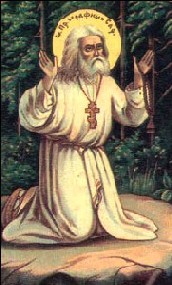
If it is impossible to find an elder who can guide one to contemplative life, then in that case one must be guided by the Holy Scriptures, for the Lord Himself commands us to learn from the Scriptures, saying:“Search the Scriptures, for in them ye shall have eternal life” (John 5:39).
We must also attentively read the writings of the Holy Fathers and try as much as possible to do what they teach, and thus, little by little, to pass from an active life to the perfection of a contemplative one. But we should not leave off the active life even when we have had some measure of success in it and have gone on to contemplation, because the active life assists the contemplative life and perfects it.
Having moved onto the path of a contemplative life, we should not falter or leave this path only because other people around us, who have attached themselves to external and sensual things, try in every way to distract us from the inner path, putting up all kinds of impediments; for according to the Church Fathers, contemplation of spiritual things is preferable to knowledge of material things. For this reason we should not be swayed by any opposition in our passing along this path, being affirmed in it by the words of God: “Their fear shall not frighten us or make us tremble, for God is with us. We shall sanctify the Lord our God, and He shall be our awe” (Isaiah 3:12-13).
The reasons for the coming of Jesus Christ into the world
The reasons for the coming of Jesus Christ, the Son of God, into the world are as follows:
(1) God’s love for mankind: “For God so loved the world, that He gave His only-begotten Son to the world” (John 3:16).
(2) The reconstruction of God’s image and likeness in fallen man.
(3) The salvation of human souls: “For God sent not His Son into the world to condemn the world, but that the world through Him might be saved” (John 3:17).
Thus, following the aim of our Redeemer, the Lord Jesus Christ, we must lead our lives in accordance with His divine teaching, in order to thereby achieve the salvation of our souls.
Reprinted from “Orthodox Life,” No. 23/24, 1932.
|