|
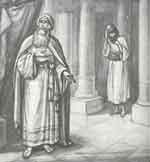
The publican was a sinner, and we all are sinners, despite our coming to church, keeping the fasts and being charitable. But the publican did something which justified him, elevated him, attracted God’s grace to him - the publican repented, the publican recognized his sins, recognized the destructiveness of these sins, the publican asked God for forgiveness. And all of this the publican was able to achieve through humility, through deep and complete humility. The feeling of humility enlightened his soul, gave him the opportunity to see himself in a true light, and showed him the right course of action. Humility led to repentance, and repentance led to forgiveness and purification. The example of the publican and the Pharisee demonstrates to us the actuality of God’s words that the Lord opposes the proud and gives grace to the humble.
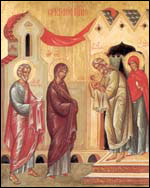
And in his amazing humility the publican received the same joy that was granted to the righteous Simeon: he saw the Lord and was given absolution. Led by the Holy Spirit, Simeon came to the temple and with his physical eyes saw the Infant Christ, saw the salvation of the world, and was released from the burden of his long life on earth. The publican, led by his conscience, which is the voice of God within us, also came to the temple, and through humility and repentance was transformed by the grace of God, saw God with the eyes of his soul, saw his own salvation, and was released from the burden of his many sins.
And the righteous Simeon, who was promised that he would see with his own eyes the Lord, our Saviour, saw Him nowhere else but in the temple. It was to the temple that the Holy Spirit led him to meet the Messiah. Thus we, too, my dear friends, can meet the Lord only in the temple, in the church. In church we not only see Him in His icons, we not only hear Him in the reading of the Holy Gospel, but we have something far greater than had the publican, far greater than had the righteous Simeon: in church we are united with the Lord Himself through the sacrament of communion. And we can attain this supreme joy only by coming to church, only by placing our soul into a state of complete humility, only by sincerely repenting our sins and being absolved of them in the sacrament of confession.
“Let us flee the haughty utterances of the Pharisee, and let us learn the sublimity of the publican’s humble words” - urges us the Church in the kontakion for the Sunday of the Publican and the Pharisee. Beginning on that day the preparatory period for the Great Lent, my dear friends, let us heed the voice of the Church, which admonishes us to avoid the Pharisee’s complacency and boasting, and instead to ascend the height of spiritual life which is contained in the words of the publican: “God, have mercy on me, a sinner.” Then we, too, when we reach the end of our earthly life, will be peacefully released by the Lord God into life eternal. Amen.
Homily for the Entry of the Lord into Jerusalem
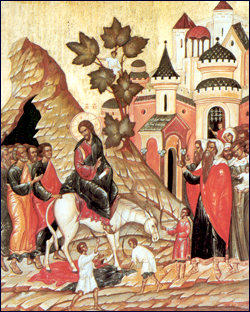
Today, dear brethren, we commemorate that triumphant day nearly 2,000 ago, when the populace of Jerusalem welcomed our Lord Jesus Christ into the city and greeted Him joyously, celebrating the arrival of their Saviour, the Messiah. Everyone was full of joy and celebration; only the Lord alone was sad and sorrowful.
He was sorrowful, because in this present joy He foresaw the forthcoming lies and betrayal. The same people who today sang laudations to Him, tomorrow would mock Him, beat Him cruelly, and, in the end, would cry: “Crucify, crucify Him!”
But those were the people of former times – you will say, dear brethren. Those were the inhabitants of Jerusalem. We had no part in those events. However, knowledge of all that took place in Jerusalem in those days has reached us, too. But how did it reach us – only as a rumor, as a narrative, or did it pierce our very soul? Did our heart truly feel that terrible betrayal, that terrible outrage against the Son of God?
The Pharisees and the scribes, those elders of the people of Israel, knew full well Whom they were murdering, but the rest of the people were expecting an earthly king and were, therefore, unaware of the truth of all that was happening. But we now know much more. From the Holy Apostles and Evangelists we know all about what happened there, so our betrayal of the Saviour is far worse than the betrayal on the part of the people of those times.
Each one of you will say, of course: “But I have not betrayed the Lord!” However, let us ponder the following, dear brethren: if we do not follow God’s commandments on loving God and our neighbors – is that not a betrayal of the Lord? If we do not forgive others, do not offer charity, do not keep the fasts, – is that not a betrayal of the Lord? If we do not come to church for all the services – is that not a betrayal of the Lord? If, while standing in church, we do not immerse ourselves in prayer, but let our thoughts wander over all manner of earthly cares and concerns, and if we do not pray at home, even though prayer is our direct contact with God, – is that not a betrayal of the Lord?
Today we have gathered here in this church, and we have sung hymns to the Lord, just as the populace of Jerusalem did nearly 2,000 years ago: “Hosannah in the highest, blessed is He Who comes in the name of the Lord.” But what will we do the rest of the week? Will we, together with those same inhabitants of Jerusalem, revile God by our inattentiveness to His passion?
No, dear brethren, let us all gather together in the church, just as we did today, and together with the Most Holy Theotokos, the holy women who remained faithful to Christ, and His loyal disciples, – let us agonize and shed tears over the unholy betrayal to which our Lord Jesus Christ was subjected for the sake of our salvation. Then we, too, will participate together with them in the joy of the forthcoming Resurrection of Christ. Amen.
Father Rostislav Sheniloff. |